
Planning Policy Statements
Planning Policy Statements
PS01 Architectural Aspirations
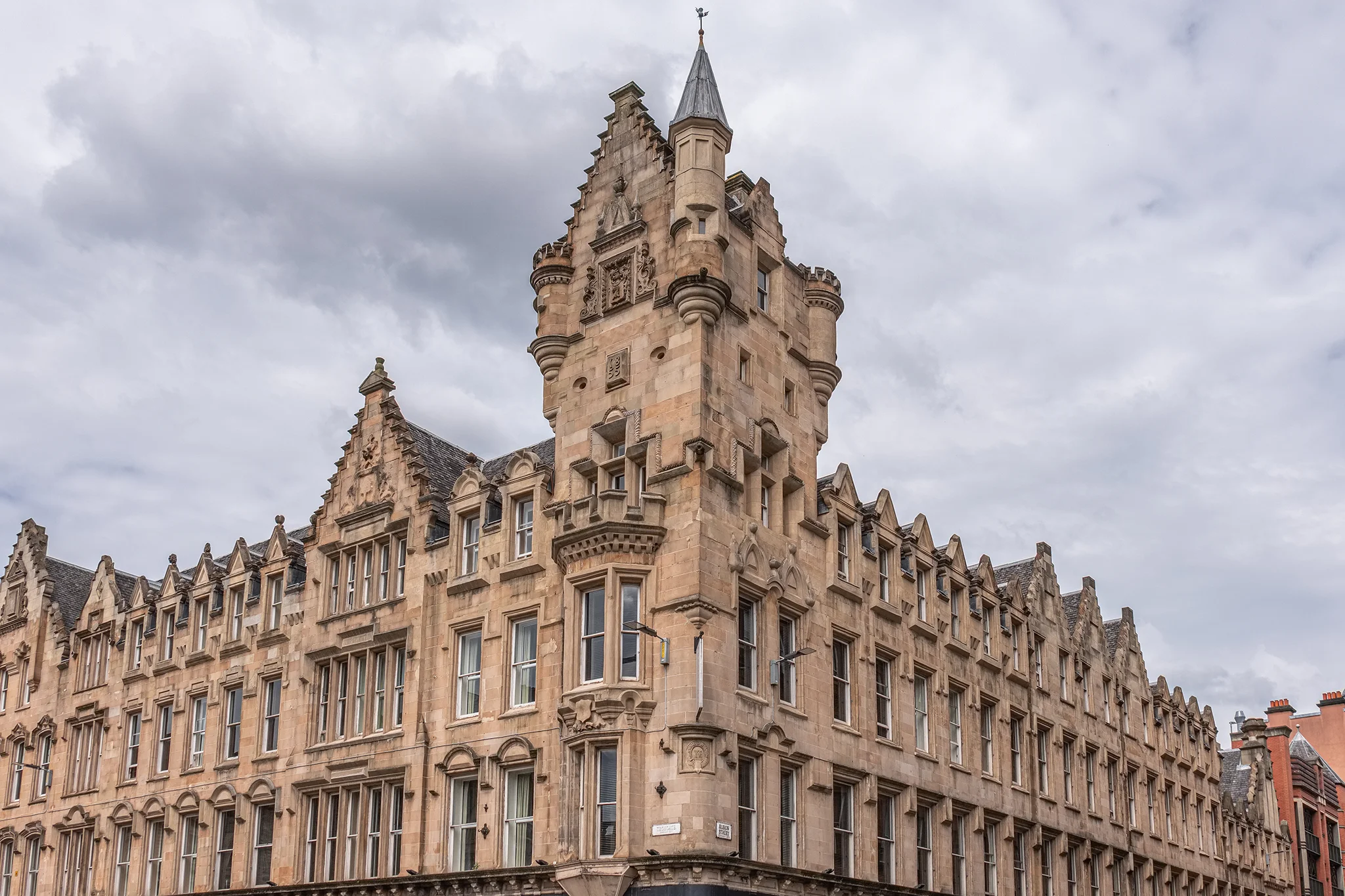
MCTCC’s general view is that development Planning Applications for ‘inner city’ areas, like Merchant City and Trongate, should be restricted to fit well with adjacent existing, and/ or accepted, established architectural scale, materiality, quality, and tradition. MCTCC is open to ‘modern’ architecture that works within these values.
PS02 Existing Architectural Scales, Materiality, Quality, Traditions and Historical Context
Our expectations are that any development design team will undertake studies to explore the architectural heritage of any site under consideration with a view to incorporating legacy lessons learnt into their proposals.
MCTCC recognises that new Development schemes are most likely to be ‘modern’ in aesthetics, but prefers proposals that have deferred to heritage legacy, learnt from that, and have considered combining a modern approach with ‘traditional’ existing architectural scale, materiality, quality, detail and tradition.
Our expectations are that new developments are designed to be sympathetic to Glasgow heritage. MCTCC requires that development design teams propose solutions that demonstrate architectural merit with creative character and visual interest, thereby offering solutions that are conducive to the health and wellbeing of the city and its inhabitants.
MCTCC’s expectation in particular is that any development design team will take all positive actions to ensure that existing traditional stone facades will be retained within their proposed schematics, with restoration where needed.
MCTCC requires that, in the case where a new development proposes the demolition of existing traditional stone facades, the case for removal is clearly demonstrable and proven by professional testimony AND corroborated by further, independent, professional, ‘2nd opinion’ contribution.
PS03 Architectural Scale, and Tradition/ Tall Buildings
MCTCC accepts financial model cases that require Developments to be tall buildings. However, this should be in appropriate situations within consented Planning guidelines and/ or accepted parameters. That being the case, MCTCC believe that ‘tall’ development schemes should still reflect the architectural traditions and history of any site location.
PS04 Financial Viability – Hotel Accommodation
MCTCC is concerned about the amount of hotel accommodation being proposed in central Glasgow. It welcomes usage diversity by development teams, as far as possible encompassing hotel, apart-hotel, residential, and retail opportunities, etc.
MCTCC requires that development teams incorporate designs to facilitate readily-achievable change to that planned in order to accommodate future market change, either during design stages or post construction.
PS05 Financial Viability – Student Accommodation
MCTCC is concerned about the amount of student accommodation being proposed in Glasgow generally, and while we welcome the increased population and the increased ‘ambiance’ that will bring, we are concerned that the proposals for so many students may not be economically ‘sound’ and that, with an emphasis on student accommodation, full traditional residential potential may be compromised.
MCTCC is not against student accommodation, per se, in the right situation. For example, we are supportive of proposals for student accommodation where that restores ‘life’ to derelict, or under-utilised buildings, particularly those of historic and architectural interest.
MCTCC’s view is that the overall amount of planned Glasgow student accommodation may be questionable, possibly not ‘safe’, and is further concerned that if market demand alters then the Developer may be left with vacant floor space to contend with, should no ‘forward planning’ be incorporated.
MCTCC requires that provision is incorporated into any development design to facilitate readily- achievable change to any scheme, at design stage development, or, indeed, to post construction, to accommodate future market change.
PS06 Financial Viability – Housing Accommodation
MCTCC supports development proposals that accommodate usage much needed in the City, primarily full residential accommodation (either housing or apartment).
MCTCC supports development proposals that aim to convert to full residential accommodation upper levels of commercial, or retail-orientated buildings within the City that are not occupied, (either apartments, or assisted/ social housing apartments).
MCTCC supports National Planning Framework 4 (NPF4) guidelines in general and in particular on the NPF4 recommended percentage of total housing given over to Assisted/ Social Housing, in any housing Development.
We require that provision is incorporated into any development design to facilitate readily- achievable change to scheme, at design stage development, or indeed to post construction, to accommodate future market change.
PS07 Ground Level Retail, Restaurant and Similar Usage
MCTCC is concerned that, whether hotel, student accommodation, or housing proposals, at Ground level at least there is where appropriate a continuous and consistent retail frontage to discipline the presentation to street, and therefore to promote, maintain and encourage ‘footfall’ and good site ‘animation’.
For any Development scheme MCTCC requires a uniform datum and uniform detailing at ground level that forms a substantially continuous presentation for retail, restaurant and similar usage sub-letting.
PS08 Conflicting or Parallel Development Coordination
MCTCC is concerned that potentially conflicting Development design proposals are advanced with less than acceptable liaison between respective design teams. We expect full and proper liaison is carried out between respective and conflicts resolved prior presentation for public consultation.
PS09 Contribution to Local Environment Improvement
MCTCC recognises that many areas of Glasgow are less than ideal environmentally. It supports development proposals that include contributions to local environment street-scape improvements, including ‘greening’. Its expectation is that these improvements will include, but not limited to, improved lighting, walkways, street signage, street furniture, and street planting, etc.
Construction sites should not be left derelict for long periods of time. They can become eyesores, detrimental to the wellbeing of local residents and visitors, and to the city’s image. We require Glasgow City Council to take appropriate urgent action to have them cleaned up and the requisite planning permission(s) to be expedited and actioned.
PS10 Improvements to Public Facilities
MCTCC’s expectation is that any Development proposals should factor in the provision of new, additional ‘neighbourhood’ facilities, such as public toilets, food provision, medical practices, etc to support anticipated new and increased street ‘animation’.
It expects new or enhanced facilities to be supported by robust management strategies to maintain safe ‘footfall’, encouraging good pedestrian use and good site ‘animation’.
Recycling facilities (including paper, plastic, glass, food and textile) should be regularly re-assessed to fit in with public needs and contribute to fulfilment of the Net Zero policies of Glasgow City Council and the Scottish Government.
PS11 Integration of and Improvement of Adjacent Thoroughfares
MCTCC’s expectation is that proposed development schemes should improve the adjacent street network and surrounding areas.
PS12 Integration of Public Transport
MCTCC requires that any Development enhances the provision of public transport.
PS13 Hard and Soft Landscaping
MCTCC recognises that the Avenues programme is the agreed ‘backbone’ for Glasgow cityscape improvements, both in the MCTCC area and beyond. That supplemented by various Developer-led proposals currently underway. This ‘backbone’, however, ‘Avenues’ leaves a whole raft of streets untreated, barren, not contributing to environmental and general wellbeing improvements.
MCTCC supports supplementary ‘lighter touch’ cityscape tree planting programmes, wherever possible, complementary to ‘Avenues’, and spreading Avenues influence wider into the MCTCC community.
We require that all hard and soft landscaping schemes are supported by robust management strategies, incorporated to promote and maintain sustainability and encourage pedestrian ‘footfall’ and good site ‘animation’.
Generally, MCTCC supports the expansion of the concept of ‘people friendly environments’ that enhance the pedestrian wellbeing experience while encouraging attractive business robustness.
We require protection of all existing mature trees within our area, together with proper regular maintenance and watering provision. MCTCC requires that mature trees within our area that have expired are replaced with new mature trees within one calendar season of expiry of the old.
PS14 Environmental Protection
MCTCC anticipates that construction of any development proposals will be disruptive to local residents and passers-by’s ‘quiet enjoyment’.
It supports development proposals where there is a commitment to Considerate Contractor’s schemes and to frequent liaison with neighbours to minimise disruption. MCTCC would prefer to be participants in forming any Development’s strategy to minimise environmental disruption, including noise.
PS15 Murals
All proposed murals, as defined by the term, shall be required to be submitted for full scrutiny under current and future Planning Applications procedures and regulations.
No installation shall be excluded from such scrutiny whether intended to be of a permanent or temporary nature, and shall be required to obtain full Planning Permission, with or without Conditions.
PS16 River Clyde Bank-side
MCTCC supports the redevelopment of the river bank-side, and its immediate hinterland and street ‘tributaries’, within the whole MCTCC curtilage, to the benefit of residents and visitors. That is between (Jamaica) Glasgow Bridge and Albert Bridge.
MCTCC encourages the upgrading of all bridges landing bank-side within this catchment area, notably including improvements/ enhancements to lighting and landscaping, but, also, general maintenance. That is; (Jamaica) Glasgow Bridge, the (pedestrian) South Portland Suspension Bridge, Victoria Bridge, City Union (rail) Bridge and Albert Bridge. It encourages the enabling of potential use of the river for transport and leisure purposes.
PS17 Community Fund
MCTCC’s expectation is that if a development within MCTCC requires a developer to contribute to a Community Fund for tree planting or otherwise as compensation for loss of the same on site that money should be spent within MCTCC boundaries and not elsewhere as is the current practice.
PS18 Historic Environment and Public Realm Protection
Within conservation areas and adjoining sites in the Merchant City and Trongate area, any premises with large outdoor displays, poor-quality furniture, and inappropriate advertising that diminish amenity or character and dominate the streetscape, will not be supported.
With respect to Glasgow City Council’s placemaking principles, MCTCC supports public spaces within the Merchant City and Trongate area remaining safe, accessible and uncluttered. Outdoor seating, structures or displays that disregard licensing conditions, obstruct pedestrian routes , or compromise inclusion, accessibility and safety will not be supported.
Published June 2026

Current Licensing Applications - 13th October
Glasgow City Council Licensing Board notify community councils of newly lodged licensing applications, as we are a statutory consultee. Anyone can make representations about proposed licensing applications. For more information visit the Licensing Board website. To find out how to make a representation, visit https://www.glasgow.gov.uk/article/1095/Make-an-Objection-or-Representation
Current Licensing Applications
| Reference | Premises | Address | Application Type | Details | Last date for comments |
| MO00447 | George Square | George Square, Glasgow, G2 1DU | Market Licensing Application Notification | Proposed Days and Hours of Opening:- 19th November 2026 until 1st January 2027:- Bar – 11.00am until 11.00pm/Outside 10.00pm Food – 11.00am until 10.45pm Music – 12 Noon until 10.00pm 31st December 2026 will extend to 1:00am on 1st January 2027. Last orders at the bar will occur strictly at 00:30am |
6 November 2026 |
Temporary Public Entertainment Licence
| Reference | Premises | Address | Application Type | Details | Last date for comments |
| PEL01505 | Clydeside Halls | The Briggait, 141 Bridgegate, Glasgow G1 5HZ | Temporary Public Entertainment Licence | Electronic dance music event with AV, bars and catering
Proposed Days and Hours of Opening:- |
4 November 2026 |
Last updated 13th October 2026
Redevelopment of King St Car Park - Planning Application
Redevelopment of King St Car Park - Planning Application
Comments close Monday 22nd September
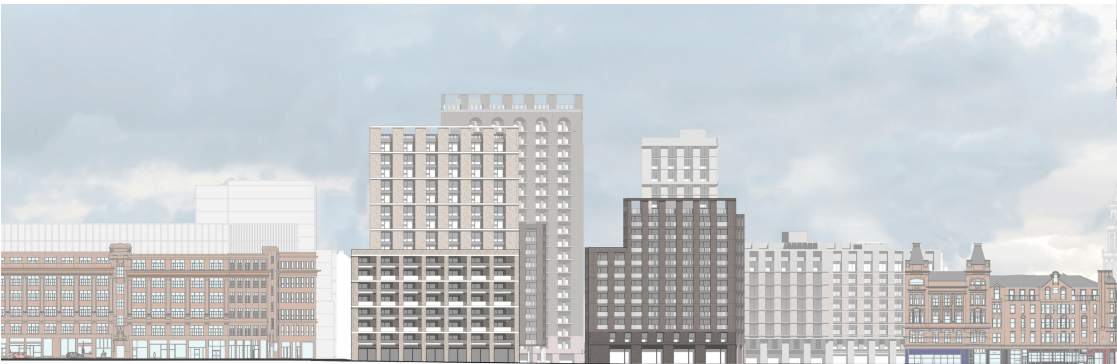
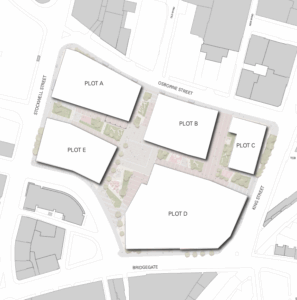
An application forPlanning Permission in Principle has been submitted for the King St Car Park site, which will comprise several buildings. A Proposed elevation, looking north from Bridgegate, is shown above. The Development Framework (parts 1 - 5) give a good insight to what the development might look like.
As you can see, there are 5 proposed buildings, of different heights.
If you want to make a comment, they can be made via the Council’s online portal or in writing.
Please note, Glasgow City Council can only take “material considerations” into account in determining the application. Please review their guide to Commenting On Planning Applications for more information.
Current Planning Applications - 11th June
Comments on the applications below can be made via the Council’s online portal or in writing. Glasgow City Council can only take “material considerations” into account in determining the application. Please review their guide to Commenting On Planning Applications for more information.
General Planning Applications
| Reference | Summary | Address | Last Date for comments |
| 26/00694/FUL | Use of office (Class 4) as student accommodation (Sui Generis), including external alterations with associated ancillary development. | Granite House 31 Stockwell Street Glasgow | 12/06/2026 |
| 26/00697/LBA | Internal and external alterations to listed building | Granite House 31 Stockwell Street Glasgow | 12/06/2026 |
| 26/00747/FUL | Preservation works to leaded glass with associated stone repairs | The Ramshorn Theatre 98 Ingram Street Glasgow G1 1EX | 12/06/2026 |
| 26/00983/FUL | Frontage alterations | 203 Argyle Street Glasgow G2 8BU | 25/06/2026 |
| 26/01050/LBA | Installation of condenser unit to roof with associated internal works | 10 Montrose St, Glasgow | 03/07/2026 |
| 26/01051/FUL | Installation of condenser unit to roof. | 10 Montrose St, Glasgow | 03/07/2026 |
Advertising Applications
| Reference | Summary | Address | Last Date for comments |
| 26/00984/ADV | Display of various illuminated and non-illuminated signage | 203 Argyle Street Glasgow G2 8BU | 19/06/2026 |
Updated 11th June 2026. Information provided by Glasgow City Council
Tall Buildings in Glasgow - Public Consultation
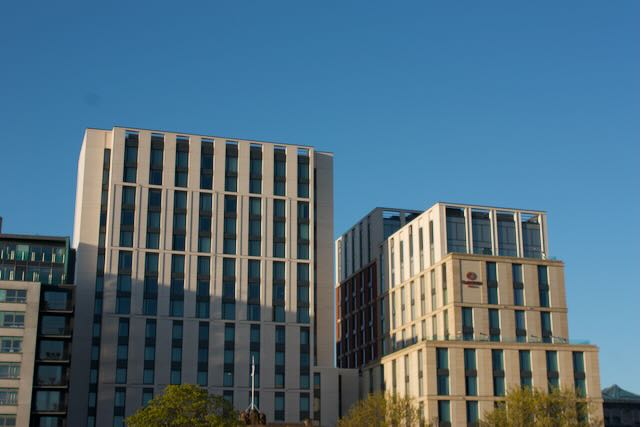
A public consultation on Tall Buildings in Glasgow has begun in response to the increasing number of these being built and planned, especially in the city centre and on its fringes.
The consultation will run until 30 September, and will help to shape the final design guidance on Tall Buildings - which not only guides the best location and design principles for these, but is a key factor in the determination of planning applications.
Given the increasing pressure to develop these types of buildings, the trend to add additional height to re purposed buildings, and the move to the re-densification and re-population of the city centre, it became clear that further design guidance was necessary.
While strategies such as the Central District Regeneration Framework, City Centre Strategic Development Framework and the River Clyde Strategic Development Framework identify opportunities for increased density and increased height along the Clydeside, it is also considered important to maintain the character of the Glasgow Central Conservation Area.
There are a range of views on Tall Buildings, with many people proposing that they can help reduce sprawl, increase density, and provide opportunities for refurbishment and re-use. Others suggest that they are inherently unsustainable, with a greater consumption of more materials, energy, and resources than lower-rise buildings, and create social and environmental problems.
Glasgow City Council recognises the role taller buildings can play in terms of sustainable and organic growth of the city system, and encourages competent, forward thinking and holistic responses to the challenges of planning, constructing, and maintaining taller buildings - so tall buildings can be sustainable if they are designed and built with care and innovation, and if they are part of a holistic urban planning strategy that balances environmental, economic, and socio-cultural aspects. However, the council does not view tall buildings are not a panacea for urban sustainability challenges and should be complemented by other forms of low and medium-impact development that promote diversity, liveability and inclusive economic growth.
Current design guidance on Tall Buildings is based on the following factors:
- Quality of the city centre: the distinctive qualities and values of this distinctive place including historic character and context;
- Heritage: understanding the significance of the local historic environment and the potential impact on this significance;
- Visual: the impact on the city centre streetscape, and wider urban landscapes, and views of the skyline. This includes the setting of heritage assets;
- Functional: the design, embodied carbon and carbon cost, construction and operation;
- Transport: the impact on the local transport infrastructure and particularly public transport needs;
- Environmental: the influence on local micro-climates such as creation of wind tunnels, 'canyon' effects, distances between tall buildings, overshadowing, and effect on heritage assets in terms of the impact these micro-climatic changes could have upon their fabric, and how they are experienced; and
- Cumulative: the combined impacts on heritage assets from existing, consented and proposed tall buildings.
The Tall Buildings design guidance was considered earlier this year at meetings hosted by the Glasgow Design Panel and attended by architects, designers and developers, a meeting with Ward 10 (Anderston/city/Yorkhill) community councils, and last month the council hosted a digital round table workshop for UK and international professional and academic experts with previous expertise in producing tall buildings design guidance for similar scale cities to Glasgow. The consultation beginning today will help shape the final design guidance document and is open to anyone with an interest in this topic in Glasgow.
This consultation can be found here.
Information from Glasgow City Council - published by MCTCC 9 July 2024
Have your say on proposals for student accommodation on Osborne St – come along to Granite House, 31 – 33 Stockwell Street on 20th February between 2 – 7pm to see what is being proposed for what is currently a gap site.
Glasgow City Council's Decision re 65-97 Ingram St
Residents have reacted furiously to Glasgow Council’s decision to destroy what they claim is the final opportunity for a community park in the city’s heart.
On the casting vote of its Chairman, the Council’s Planning Applications Committee (PAC) voted after a three hour public hearing to agree planning officers’ recommendation of approval for a seven storey building of 109 apartments on the site. This is currently a car park opposite the historic ‘A’ Listed Ramshorn Church.
Almost half the 14 members of the Committee failed to turn up for the hearing, described by Merchant City and Trongate Community Council (MCTCC) as the most important event for local residents in the past 20 years and the culmination of its four year fight for the area’s first green space.
The decision means 21 horse chestnut and cherry trees will be felled. The site, sold by the Council to its own arms length property company, is also home to the world famous mural ‘Fellow Glasgow Residents,’ showing a variety of wild animals and birds peeking through what appear to be holes in a wall.
Tam Coyle, Chair of MCTCC which was one of 143 objectors, commented: “We are devastated and angry at the outcome. It’s ironic since Glasgow was host of the COP 26 UN Climate Change Summit and its leaders have regularly spoken about how determined they are to boost the greening of the city.”
He added: “It has now ruined the last remaining opportunity for a community park in the very heart of the city. No other site is available.”
An acoustics expert told the hearing that residents of the new flats would have legitimate grounds for complaint about noise from the adjacent City Halls and Old Fruitmarket entertainment complexes which host well over 200 events a year and that this could put their continued existence in doubt.
Depute Lord Provost Christy Mearns commented: “I’m bitterly disappointed that Councillors have voted to obliterate the last available open space in Merchant City and putting world-renowned music venues under significant threat of closure.”
She went on: “Unfortunately there is now no chance of ever creating a park here, despite the area crying out for it. The Council says it wants to encourage families and children to live in the city centre yet there is nowhere for them to play or gather. We need new homes but these should be prioritised in appropriate locations”.
Mr Coyle noted that Glasgow had recently come 68th and last in a survey of the greenest cities in Britain carried out by university scientists from England and Australia.
The PAC’s vote was 3-3 but carried on the casting vote of Councillor Ken Andrew (SNP Hillhead).
Mr Coyle commented: “This decision, waved through on the casting vote of one person, is a travesty. It sends absolutely the wrong signal about Glasgow Council’s long repeated mantra of wanting a greener environment for its citizens.”
Other objectors said the proposed development was out of context with existing buildings and hide views of the Ramshorn which dates back to 1720, and add to already serious traffic problems in the area, especially since the proposal had no provision for parking spaces.
Local resident David Hughes told the hearing that Merchant City was the only part of the city centre without a green space and that a park would boost the community’s health and well being,
Public Consultation - Proposed erection of student accommodation, Trongate/Hutcheson St
The second public consultation event for the proposed demolition and redevelopment of the site on the corner of Hutcheson St/Trongate will take place this Wednesday, 11th January, in Metropolitan Bar, Candleriggs, between 12noon and 7pm. The proposal has been updated following feedback from the first public consultation.
Avenues Consultation - Argyle St East/St Enoch Sq/Dixon St (Online)
Changes are being made to Argyle Street east of Central Station, St Enoch Square, Dixon Street and around Barrowlands Park as part of the Glasgow Avenues Programme.
The proposed changes focus on protecting and prioritising space for active travel, improving connectivity, introducing sustainable green infrastructure and improving the way public transport is accommodated.
You can find out more about the proposals by:
- Visiting St Enoch Centre on Monday 25th July between approximately 10am and 6pm, to meet the team, see the proposals and have your questions answered.
- Viewing the proposals online at www.glasgow.gov.uk/avenues
- Joining an online presentation on Wednesday 27th July ay 7pm, where we will explain the proposals and provide an opportunity to ask questions.
Visit https://www.eventbrite.co.uk/e/glasgow-avenues-argyle-street-east-registration-372832832037 to register
Meet Our Waterfront Drop-in Session
Meet Our Waterfront is a project commissioned by Glasgow City Council to develop an urban masterplan for Custom House Quay and Carlton Place. The urban masterplan formed on the basis of a new structural quay wall built into the river, providing new development plots, new high quality public realm (of at least equal quantum to that existing in the area) and improving connectivity along the river edge.
These sessions will provide an opportunity to view the emerging designs, and discuss opportunities. During the event the design team will be on hand with visual materials to prompt conversation and gather your feedback on the emerging proposals for Custom House Quay and Carlton Place.
No need to book - just drop-in any time during the following periods:
Wednesday 6th October: 11 am - 2 pm
Wednesday 6th October: 5 - 8 pm
Thursday 7th October: 11am - 2 pm
Thursday 7th October: 5 - 8 pm
Fore more information, visit https://www.eventbrite.co.uk/e/meet-our-waterfront-meet-the-design-team-tickets-174273706347